Hiking
Hiking Safety for Beginners: 12 Tips for Safer Trails
Updated November 2026
Hiking is one of the simplest ways to spend more time outdoors. You don't need expensive equipment, years of experience, or the ability to hike ten miles to enjoy a trail.
But even a short hike deserves a little preparation.
Weather changes, trails become confusing, and small mistakes can turn an enjoyable afternoon into a stressful experience. The good news? Most beginner hiking risks can be reduced with a few practical habits.
Whether you're planning your first nature trail or exploring a mountain path for the first time, these 12 hiking safety tips will help you feel more prepared.
Quick Hiking Safety Checklist
Before heading out, make sure you can answer these questions:
The Plan
- Have I checked the weather forecast and trail conditions?
- Do I know the trail distance and difficulty?
- Have I downloaded an offline map?
- Does someone know where I'm hiking and when I expect to return?
- Have I checked for any trail closures or alerts?
Your Kit and You
- Am I carrying enough water and food?
- Do I have appropriate footwear and clothing?
- Is my phone charged?
- Do I have a headlamp, basic first-aid supplies, and an emergency layer?
- Do I know when to turn around?
You don't need to be an expert to hike safely. You just need a reasonable plan.
1. Choose a Trail That Matches Your Experience
One of the most common beginner mistakes is choosing a trail based on distance alone.
A three-mile mountain trail with steep elevation changes, rocks, and exposed sections can be much harder than a five-mile walk on relatively flat ground.
Before choosing a hike, consider:
- Distance: How far will you actually walk, including the return trip?
- Elevation gain: How much climbing is involved?
- Terrain: Is the trail smooth, rocky, muddy, or steep?
- Exposure: Are there narrow sections, drop-offs, or exposed ridgelines?
- Trail conditions: Are bridges damaged, streams high, or sections closed?
For your first few hikes, start with shorter, well-marked trails where you can comfortably turn around.
As your fitness and confidence improve, gradually explore longer or more challenging routes.
Related guide: How to Plan Your First Hike
2. Check the Weather — and Prepare for Changes
Weather can change quickly outdoors, particularly in mountainous areas.
A sunny forecast at the trailhead doesn't guarantee the same conditions at higher elevations.
Check the forecast for the actual hiking area, not just the nearest town.
Pay attention to:
- Thunderstorms and lightning
- Temperature changes
- Wind and exposed ridges
- Rain and slippery trail conditions
- Heat and humidity
- Snow or ice at higher elevations
If thunderstorms are expected, consider postponing your hike or choosing a shorter route that avoids exposed areas.
If you hear thunder, seek appropriate shelter. Avoid exposed summits, isolated trees, and open ridgelines. No outdoor location is completely safe from lightning.
Even during warm weather, carry an extra layer if temperatures may drop.
Beginner tip: Decide before you leave what weather conditions would cause you to cancel or turn around.
3. Tell Someone Where You're Going
This is one of the easiest hiking safety habits to develop.
Before leaving, tell a trusted person:
- Which trail you're hiking
- Where you plan to park
- When you're starting
- Approximately when you expect to finish
- When they should contact authorities if you haven't checked in
This is especially important if you're hiking alone.
You don't need a complicated itinerary. A quick text with your trail name, parking location, and estimated return time is a good start.
Just remember to check in when you finish.
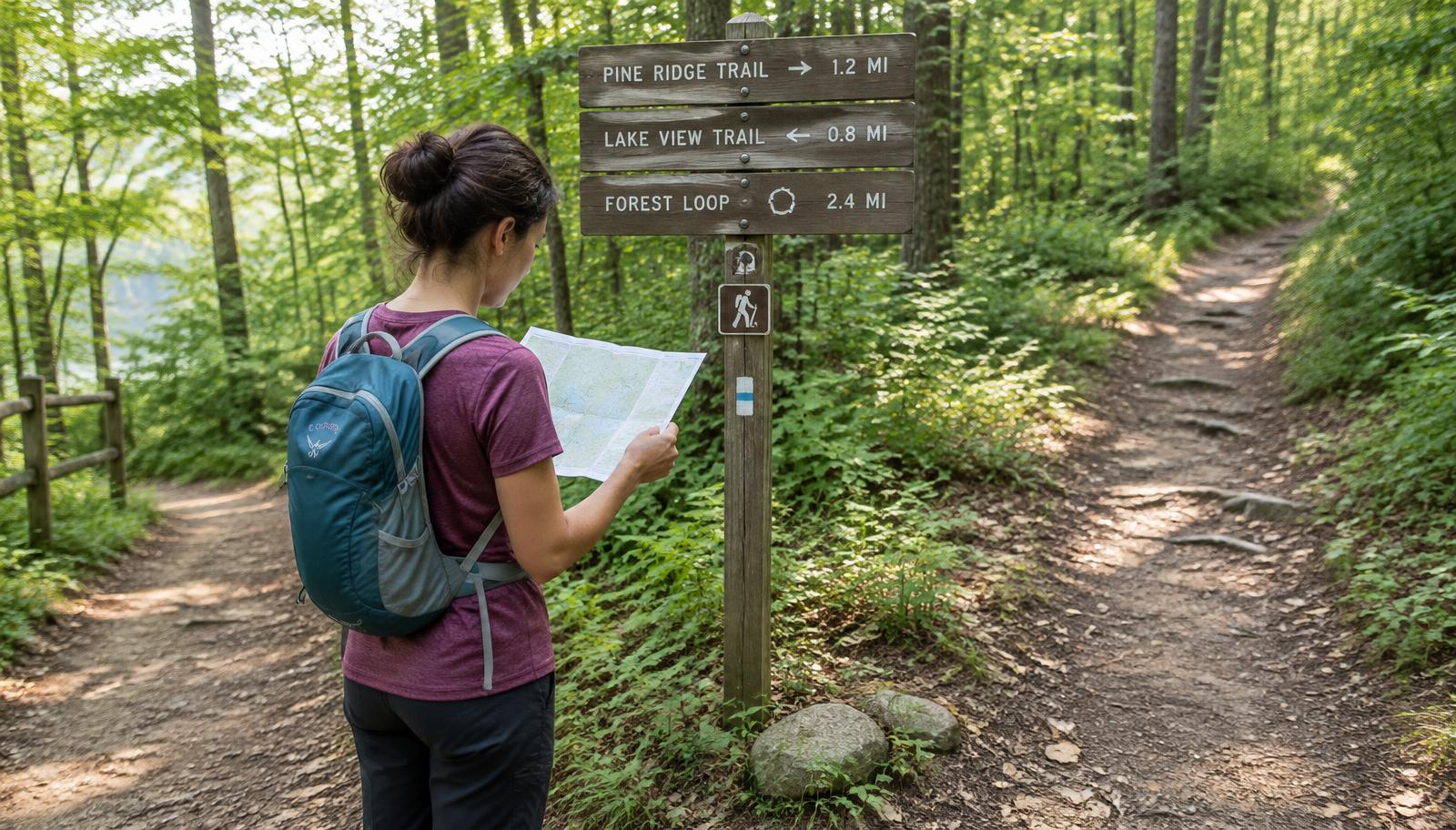
4. Download Your Map Before You Leave
Cell service can be unreliable or completely unavailable on hiking trails.
Don't assume Google Maps or another navigation app will work once you're in the woods.
Before your hike:
- Download an offline trail map.
- Identify the trailhead and major intersections.
- Review the route and turnaround points.
- Know whether the trail is a loop or out-and-back.
- Carry a paper map when the route or conditions warrant one.
Trail signs and markers are helpful, but they can be missing, damaged, or confusing.
If you reach an intersection and aren't sure which direction to take, stop and confirm your route before continuing.
Important: A downloaded map is only useful if you know how to read it and your phone still has power.
5. Carry the Essentials, Even on Short Hikes
You don't need to fill a huge backpack for an easy day hike, but a few items can make a major difference when plans change.
A basic beginner hiking kit should include:
- Water and snacks
- Navigation tools
- Weather-appropriate clothing
- A headlamp or flashlight
- Basic first-aid supplies
- Sun protection
- A whistle
- Emergency shelter or an insulating layer appropriate to the conditions
- A charged phone and, when useful, a power bank
The traditional Ten Essentials provide a useful framework, but you can adapt your kit to the trail, season, and length of your hike.
For a complete packing breakdown, read our guide to What to Bring on a Day Hike.
The goal isn't to carry everything imaginable. It's to bring enough to handle reasonable problems without overloading yourself.
6. Start Early and Know When to Turn Around
Beginners often underestimate how long a hike will take.
Taking photos, resting, climbing hills, and navigating rocky sections all add time.
Before starting, estimate how long your hike should take and allow extra time for breaks and unexpected delays.
Set a turnaround time, especially on out-and-back trails.
For example, if you need to be back at your vehicle by 4:00 p.m., decide in advance when you must start heading back, regardless of whether you've reached your destination.
Don't let the desire to reach a waterfall, overlook, or summit override your turnaround plan.
A successful hike is one you return from safely — not necessarily one where you reach the endpoint.
7. Stay on Marked Trails
Staying on established trails protects both you and the environment.
Leaving the trail can expose you to:
- Unstable ground
- Steep drop-offs
- Hidden holes or loose rocks
- Difficult navigation
- Sensitive vegetation
Shortcuts may look easier but can lead to steep terrain or unexpected obstacles.
Avoid climbing over barriers or entering closed sections.
If a trail is closed, assume there's a reason even if the hazard isn't immediately visible.
Staying on established routes also follows Leave No Trace principles by reducing damage to surrounding vegetation.
8. Understand Basic Wildlife Safety
Seeing wildlife can be one of the highlights of hiking.
The safest approach is to give animals plenty of space and never approach them for a photograph.
A few general rules apply almost everywhere:
- Never feed wildlife.
- Keep food and trash secured.
- Observe animals from a safe distance.
- Don't approach young animals.
- Never block an animal's escape route.
- Follow park-specific wildlife guidance.
If you're hiking in bear country, learn the recommendations for the species present before your trip. Black bear and grizzly bear encounters require different considerations, and bear spray may be recommended in some locations.
For hikers in the Great Smoky Mountains, black bears are part of the landscape. Most encounters end without incident when people maintain distance and follow park guidance.
Don't assume every animal will move away when it sees you.
Beginner tip: Review the official park or land-management agency's wildlife recommendations before your hike.
9. Watch Your Footing on Rocks, Roots, and Stream Crossings
Many hiking injuries come from slips, trips, and falls rather than dramatic wilderness emergencies.
Take extra care around:
- Wet rocks
- Exposed tree roots
- Loose gravel
- Steep downhill sections
- Muddy slopes
- Waterfalls and stream crossings
Slow down when footing becomes uncertain.
Use your hands for balance when appropriate, but avoid grabbing unstable branches or loose rocks.
Never assume a shallow-looking stream is safe to cross. Water can be faster, deeper, and more powerful than it appears.
If a crossing looks unsafe, turn around rather than risk it.
Also keep your distance from waterfall edges and slippery rock ledges.
10. Pay Attention to Your Body
Hiking should challenge you appropriately, not push you beyond your limits.
Take breaks when needed and watch for signs that you're becoming overly tired, dehydrated, overheated, or unusually cold.
Warning signs may include:
- Dizziness or lightheadedness
- Unusual weakness
- Headache or nausea
- Confusion
- Poor coordination
- Excessive shivering
Some symptoms can signal a medical emergency. Confusion, fainting, severe weakness, or inability to walk normally warrant urgent attention.
Rest, hydration, food, and adjusting clothing may help with minor discomfort, but don't continue hiking when serious symptoms develop.
Turn around early rather than waiting until you're exhausted.
Remember that hiking downhill can be physically demanding, too.
11. Know What to Do If You Get Lost
Getting turned around can happen even on familiar trails.
If you realize you may be lost, the most important thing is to avoid making the situation worse.
Use the STOP approach:
S — Stop. Don't keep walking in an uncertain direction.
T — Think. Consider where you last knew your location.
O — Observe. Look at your map, surroundings, trail markers, and available landmarks.
P — Plan. Decide on the safest next step based on reliable information.
If you can confidently retrace your route to a known location, that may be appropriate. Otherwise, staying in a safe place can make it easier for rescuers to find you.
If you need assistance:
- Call 911 or the appropriate local emergency number when possible.
- Share your location or coordinates if available.
- Use a whistle to attract attention.
- Conserve phone battery.
- Avoid wandering into more difficult terrain.
A phone's emergency satellite features or a dedicated satellite communicator may be useful in remote areas, but availability and capabilities vary.
The goal is to stay calm, avoid additional hazards, and make yourself easier to locate.
12. Know When to Cancel or Turn Around
Sometimes the safest hiking decision is not to continue.
Turn around or cancel when:
- Weather becomes dangerous.
- The trail is closed or badly damaged.
- You're running short on daylight.
- Someone in your group is struggling.
- Water or essential supplies are running low.
- You can't confidently identify the route.
- Conditions are beyond your experience.
Turning around isn't a failure.
Experienced hikers change plans all the time.
The trail will still be there another day.
Hiking Alone vs. Hiking With a Group
Both can be enjoyable, but they require slightly different preparation.
Hiking Alone
Solo hikers should be especially careful about route selection, communication plans, navigation, and carrying appropriate emergency supplies.
Choose familiar or well-traveled routes while building experience.
Tell someone exactly where you're going and when to expect you back.
Hiking With Others
Groups should agree on the route, pace, and turnaround time before starting.
Stay together, communicate at intersections, and avoid leaving slower hikers behind.
Plan around the least experienced member rather than the strongest.
Common Hiking Safety Mistakes Beginners Make
Relying entirely on cell service: Download maps before leaving.
Starting too late: Allow enough daylight for the return hike.
Wearing brand-new footwear: Test shoes on shorter walks first.
Ignoring weather changes: Reassess conditions throughout the hike.
Packing too little water: Plan for the weather, effort, and available water sources.
Pushing through exhaustion: Take breaks and turn around when necessary.
Leaving the trail for shortcuts: Stay on designated routes.
Not telling anyone your plans: Share your itinerary before leaving.
Most of these mistakes are easy to avoid with a little preparation.
Frequently Asked Questions
Is hiking safe for beginners?
Yes, hiking can be a safe and enjoyable activity for beginners when you choose appropriate trails, prepare for conditions, carry essential supplies, and recognize when to turn around. No outdoor activity is completely risk-free.
What is the most important hiking safety tip?
Choose a trail appropriate for your experience and prepare before leaving. Knowing your route, checking the weather, carrying essentials, and sharing your plans are all important.
Should beginners hike alone?
Beginners can hike alone, but starting with a friend or group provides additional support while learning navigation and trail habits. Solo hikers should take extra precautions.
What should I do if I see a bear?
Stay calm, keep your distance, and follow the guidance for the bear species and location. Do not approach or feed the bear. Review official park recommendations before hiking in bear country.
What should I do if I get lost hiking?
Stop moving, assess your surroundings, check your map, and avoid wandering farther into unfamiliar terrain. If you cannot safely navigate back, seek assistance and make your location known.
How much water should I bring hiking?
Water needs depend on temperature, humidity, exertion, personal factors, and hike duration. Bring enough for the planned route plus a reasonable reserve, and don't rely on untreated natural water sources.
Final Thoughts: Confidence Comes From Preparation
You don't need to be fearless to enjoy hiking.
You need to know your limits, prepare for the trail ahead, and make thoughtful decisions when conditions change.
Start with manageable trails. Build experience gradually. Learn something from every hike.
The more time you spend outdoors, the more natural these habits become.
And remember: the goal isn't to prove how far you can go.
It's to enjoy the trail and make it home safely.
Keep Exploring
How to Plan Your First Hike
Choose a trail, estimate your time, and prepare for the day.
Read the guide →
What to Bring on a Day Hike
Build a practical packing list for water, food, clothing, navigation, and safety essentials.
Read the guide →
What to Wear Hiking
Choose comfortable footwear, clothing, and layers.
Read the guide →
Best Hiking Gear for Beginners
Explore practical gear choices when you're ready to upgrade.
Read the guide →
Or return to the Hiking Hub.
Explore. Prepare. Get Outside.